Keeping Your Kid's Bedtime Routine Consistent Across Two Households
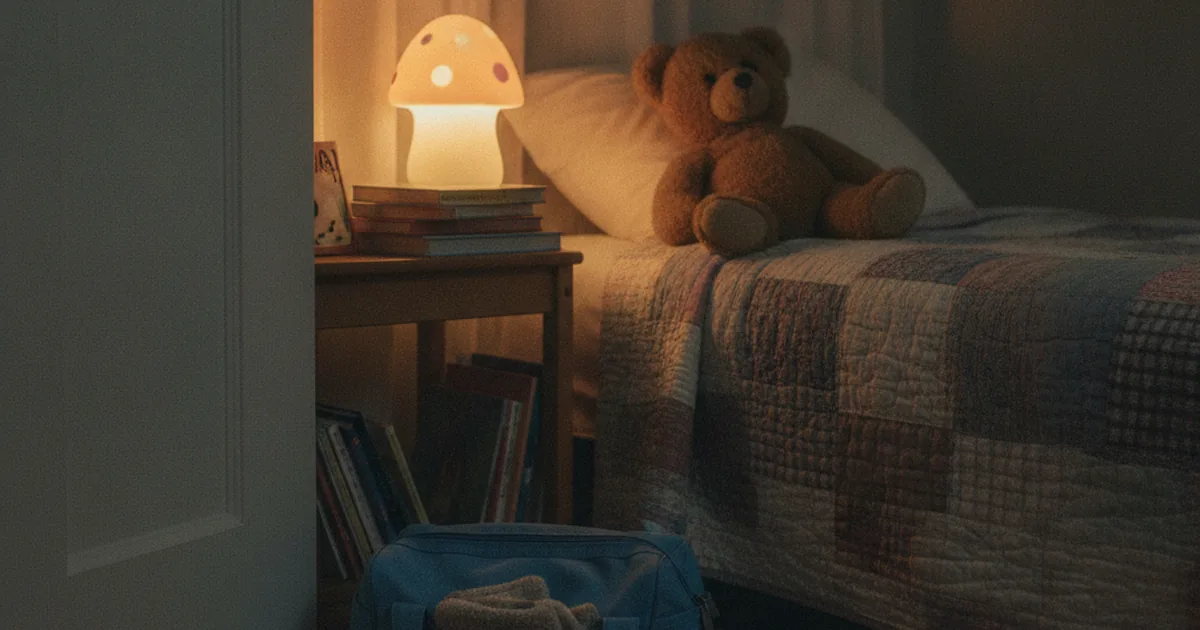
If your child splits nights between two homes, you've probably already noticed that bedtime is one of the first things to wobble — a rougher first night back, more stalling, more "but at Dad's/Mum's we..." negotiating. It's tempting to read that as evidence the whole arrangement is unsettling your child, but in most cases it's something much more fixable: the routine itself isn't lining up between the two houses, so your child's brain doesn't get the same clear "sleep is coming" signal it relies on. The goal isn't to make both homes identical — that's rarely realistic and not actually necessary. The goal is to make each home predictable on its own, and to agree on the few things that genuinely need to match.
Why does bedtime unravel when a child moves between two homes?
Young children build their sense that sleep is approaching almost entirely from repetition — the same sequence of small cues, night after night, in the same order. When that sequence changes depending on which house they're in, and especially when it changes on the very night of a transition, the cue gets muddier and bedtime resistance often follows. This isn't a sign of insecurity about the co-parenting arrangement itself; it's a much more mechanical problem of a routine losing its predictability. The fix follows directly from the cause: rebuild predictability, not necessarily uniformity.
What actually needs to match between both households (and what doesn't)?
Most of the arguments co-parents have about bedtime are over details that don't move the needle much. A useful split:
- Matters a lot: the order of the last 15–20 minutes before lights out (wind-down activity, hygiene step, one calming input like a story, a fixed goodnight phrase), and a general bedtime window that doesn't swing by more than an hour or two between houses.
- Matters a little: the exact clock time (a 30-minute difference is not disruptive on its own), who does the tucking-in, whether there's a bath every night or every other night.
- Doesn't really matter: bedroom decor, which stuffed animals live where, house rules about weekend bedtime, or which parent's approach to "one more request" is stricter — kids adapt to different-but-consistent rules per house without it harming sleep.
Aiming both parents' energy at the first category, rather than trying to standardize everything, tends to produce a much shorter and more successful conversation.
How do we agree on a shared routine without relitigating everything?
Write down four or five steps — not a full script, just the skeleton — and ask both households to hit them in the same order, even if the specific activity inside each step differs. For example: wind-down → hygiene → one calming story or quiet activity → same goodnight phrase → lights out. One house might do a bath every night and the other every other night; one might read a physical book and the other use an audio story; that's fine, because the skeleton, not the specific content, is what a child's brain is actually tracking. This is the same underlying idea we cover in building a short, predictable wind-down — a shorter, well-ordered routine beats a longer, inconsistent one, and that's true whether it's one house or two.
A shared "goodnight phrase" or a shared bedtime story world is often the single easiest thing to actually keep identical, since it doesn't require either household to change how they run bath time or bedroom rules. Some co-parenting families settle on the same offline audio-story app for exactly this reason — it travels on a phone or tablet between houses, so the same calm voice and story library is available regardless of whose home it is that week. That's part of why we built Sleepy Spell as a private, screen-dark app: no login friction, no ads, nothing that depends on one parent's account or setup, just the same wind-down story showing up the same way in both homes.
What if the other parent won't cooperate on a shared routine?
This is common, and it's not a reason to give up on consistency — it just means the consistency has to live inside your own home instead of being negotiated across both. A child can absolutely handle "Mum's house does X, Dad's house does Y" as long as each version is dependable on its own; what actually causes trouble is a routine that changes unpredictably within a single household, not a difference between two stable households. Focus your effort where you have control: keep your four or five steps rock-solid every night you have your child, and let go of trying to control what happens at the other house. Similar logic applies to keeping a routine together while traveling — you can't control every environment, but a portable, minimal core routine travels well regardless of the setting.
How should we handle the handoff night itself?
The night of a transition — arriving at a new house, unpacking a bag, re-adjusting — is reliably the hardest bedtime of the cycle, and it helps to expect that rather than be surprised by it. A few things that make handoff nights go better: build in 15–20 extra minutes of wind-down time rather than rushing straight into the routine; keep one or two portable anchors (a specific stuffed animal, the same bedtime story, the same goodnight phrase) present regardless of whose house it is; and resist reading a rough handoff-night bedtime as a sign that something is wrong with the arrangement. A single harder night, followed by a return to the normal routine the next day, is the expected pattern — not a red flag.
Does age change how much consistency actually matters?
Yes, meaningfully. Babies and young toddlers have almost no other way to know sleep is coming besides external cues repeated in the same order, so the two-household routine skeleton matters most for them. Preschool and school-age children can hold "this house does it a bit differently, and that's okay" as an actual concept, especially if it's explained plainly, so the priority for them shifts from strict step-by-step matching toward predictability and honest communication ("here's what bedtime looks like at Dad's, and here's what it looks like here") rather than trying to force both houses into one script.
Frequently asked questions
Do bedtimes really need to be identical at both houses?
No — the clock time can flex by 30 minutes or so without causing problems. What matters far more is the order of the last few steps before lights out (bath or wash-up, teeth, one calming activity, goodnight) staying the same in both homes, since that sequence is the actual cue a child's brain uses to wind down.
What if the other parent won't agree to any shared routine?
Control what happens in your own home and keep your half rock-solid rather than trying to negotiate every detail. A child can manage two somewhat different routines fine as long as each one is predictable on its own; the real risk is a routine that's inconsistent within a single household, not two households that differ from each other.
How do I handle the handoff night itself, when sleep is often worse?
Treat transition-day bedtime as its own category rather than expecting it to run like every other night. Build in extra wind-down time, keep the visible routine (favorite object, same last book or story, same goodnight phrase) present regardless of whose house it is, and let go of the expectation that it will be as smooth as a mid-week night at one settled home.
Should we use the same bedtime story or app in both homes?
Yes, if you can manage it — a familiar story, voice, or app that shows up identically at both houses gives a child something stable to hold onto even when the room, the rules, and the parent are different. It's one of the easiest single things to keep consistent since it doesn't require the two households to agree on anything else.
Does age change how much consistency actually matters?
Yes. Babies and toddlers rely almost entirely on external cues and routine order to know sleep is coming, so consistency matters most there. School-age children can understand and adapt to two different but explained systems, so the priority shifts from identical steps to predictability and clear communication about what to expect at each house.
Is it normal for sleep to get worse for a while after a custody change?
Yes, a temporary dip in sleep quality around a new custody arrangement or schedule change is common and doesn't mean something is wrong. Give it several weeks of steady routine at both houses before treating it as a lasting problem, and focus on what you can control (your own home's consistency) rather than the disruption itself.
This article offers general parenting guidance and isn't a substitute for advice from your child's pediatrician or a family therapist, especially if sleep disruption is severe, prolonged, or tied to a difficult custody transition.
Sources
American Academy of Pediatrics (HealthyChildren.org) — Co-Parenting Tips for Divorced Parents.
American Academy of Child & Adolescent Psychiatry — Children and Divorce.
Sleep Foundation — Perfecting Your Child's Bedtime Routine.
ZERO TO THREE — The Power of Routines.