What Color Nightlight Actually Helps Kids Sleep?
Why does light color matter for a child's sleep at all?
The body's internal clock reads light as its main cue for when to be awake and when to wind down, and it doesn't treat all light the same. Cooler, blue-toned wavelengths — the kind daylight and most white LEDs are rich in — are the most effective at suppressing melatonin, the hormone that signals it's time to sleep. Warmer, longer wavelengths like red and amber have far less of that effect, which is why sleep researchers consistently point to warm light as the safer choice once the sun goes down.
This is the same mechanism behind the advice to dim screens before bed — we've written before about the science of blue light and screens at bedtime — and it applies just as much to a lamp or nightlight left glowing in the corner of the room.
What color nightlight is actually best for sleep?
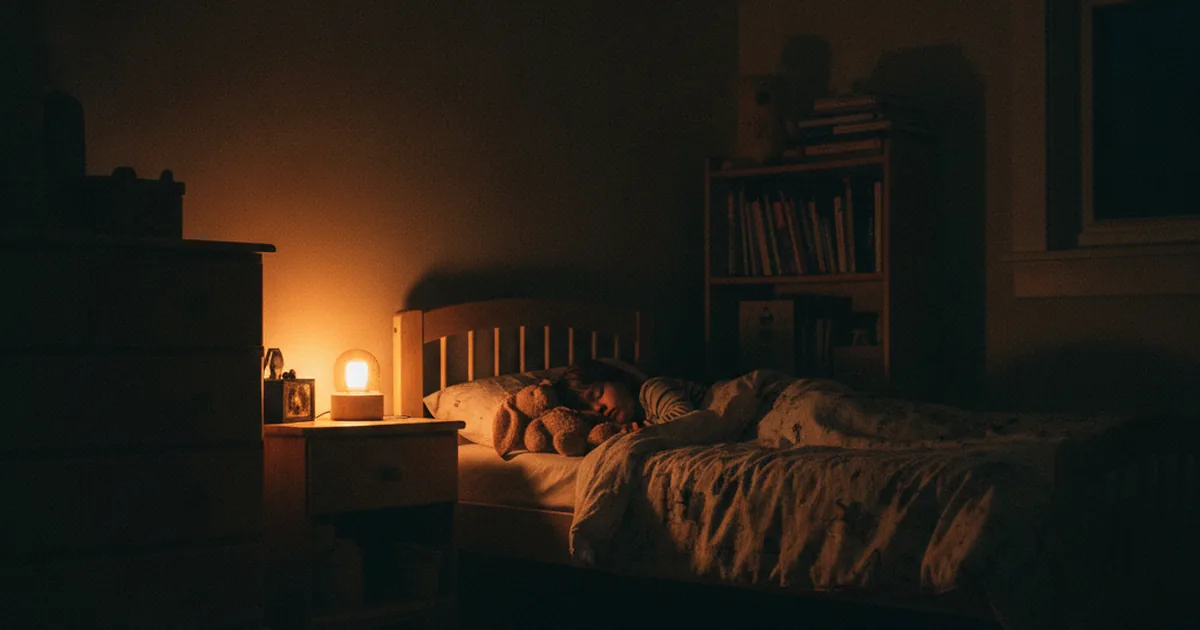
Red or amber, by a clear margin. These warm tones sit at the opposite end of the visible spectrum from the blue light that disrupts circadian signaling, so a dim red or amber glow can stay on for a whole night with minimal impact on sleep depth or onset. Many baby monitors and dedicated kids' nightlights now include a red or amber-only mode for exactly this reason.
Avoid white and blue. A "soft white" LED nightlight still emits enough blue-spectrum light to matter, especially at close range in a small, dark room where even a low-lumen bulb can dominate the available light. Cool white or blue nightlights are the worst combination for a bedroom: they're marketed as gentle, but the color itself works against the goal.
Yellow and warm orange are a reasonable middle ground if red feels too dim or too strange a color for your child's taste — both are still much lower in blue content than a typical white bulb.
How bright should it be?
Brightness matters as much as color. The goal is the dimmest light that still does its job — enough to make out the doorway, the path to the bathroom, or a step down from the bed, not enough to read by or cast crisp shadows on the ceiling. A simple test: if you can comfortably read fine print by the nightlight from across the room, it's too bright for a sleep environment.
Plug-in nightlights with a built-in light sensor (so they only switch on once the room is genuinely dark) and lights with a dimmer or low/high setting give you the most control here. A light on a motion sensor that only brightens during a nighttime bathroom trip, then fades back down, is one of the gentler options for toddlers who wake and need to see, without keeping a bright light running for hours.
Where should the nightlight go?
Placement matters more than most parents expect. A nightlight plugged in low on a wall or set on the floor casts a gentler, more indirect glow than one on a nightstand at eye level, which shines directly toward a sleeping face. Point it away from the bed, toward a doorway or hallway, rather than facing the pillow. If you use one at all in a crib room, keep it well outside the crib and off to the side rather than overhead.
What about star projectors, sound-and-light combos, or screens?
These are popular, and they're not automatically a problem — but the same two rules apply: warm color, and calm rather than stimulating. A slow, static, amber-toned projection is very different from a bright white pattern that rotates, changes color, or syncs to music. If a projector has a color and motion setting, choose the warmest, most static option and set an auto-off timer so it isn't running at full brightness for the whole night. Screens of any kind — tablets propped up for a bedtime show, or nightlights built into a video device — combine blue-heavy light with stimulating content and are worth avoiding at bedtime altogether, which is part of why audio wind-downs tend to settle kids faster than screen-based ones.
This is a place where Sleepy Spell fits naturally into the routine: it's a screen-dark, audio-only bedtime story experience, so there's no glowing tablet competing with a dim, warm nightlight for your child's attention right when the goal is to wind down, not light up.
When should I introduce a nightlight, and does it actually help with fear of the dark?
Most infants don't need a nightlight and often sleep better without one, since full darkness reinforces the day-night contrast their circadian rhythm is still calibrating in the first months. The genuine need for a nightlight usually shows up later, somewhere between ages 2 and 4, once a child's imagination has developed enough to produce real fear of the dark rather than simple unfamiliarity with it.
For an anxious or worried child at bedtime, a warm, dim, predictable nightlight can be a meaningful piece of reassurance — alongside the rest of a calming routine. We go deeper on the broader picture of helping an anxious child settle at bedtime if worry, not just darkness, is the bigger driver of resistance.
A nightlight is not, on its own, a fix for early-morning waking or frequent night wakings — those usually have other causes, like an early circadian clock, an over-bright room at dawn, or an evolving sleep association, which we cover in handling the 4 a.m. early riser.
This post reflects general sleep-hygiene guidance drawn from published sleep science and isn't medical advice. If your child has persistent, severe nighttime fear or sleep disruption, it's worth discussing with your pediatrician.
Frequently asked questions
What color nightlight is best for a child's sleep?
Red or amber light is the best choice for a child's nightlight because it suppresses melatonin production far less than white or blue-toned light. Warm, low-wavelength light lets a child's body stay in a sleep-ready state, while cooler white or blue light mimics daylight and can signal to the brain that it's time to be awake.
Is it OK for a nightlight to stay on all night?
A dim, warm-colored nightlight left on all night is generally fine and is unlikely to meaningfully disrupt sleep, especially compared with a bright white or blue light. If your child sleeps well in full darkness, there's no need to add one; if a light genuinely eases fear of the dark or nighttime trips to the bathroom, keep it as dim and warm-toned as possible.
How bright should a kids' nightlight be?
As dim as it can be while still doing its job. A good nightlight gives just enough glow to make out the doorway or a step to the bathroom, not enough to read by or cast strong shadows. If you can comfortably read fine print by it, it's too bright for a bedroom.
At what age should I introduce a nightlight?
Most infants don't need one and generally sleep better in full darkness, which also reinforces the day-night cues their circadian rhythm is still learning. Nightlights tend to become genuinely useful around age 2-4, once imagination develops enough to produce a real fear of the dark.
Do nightlight projectors or star projectors disrupt sleep?
It depends on the color and motion. A static, warm-toned projection is generally fine, but bright white or blue projections, rotating patterns, or music-and-light combos can be stimulating rather than calming right at bedtime. Look for a warm color setting and set it to turn off after your child is asleep rather than running all night on a bright setting.
Can a nightlight help with early-morning waking?
A nightlight can reduce fear-driven wake-ups, but it won't fix waking that's actually driven by an early circadian clock or a bedroom that gets bright too soon. For true early-morning waking, blackout curtains and a consistent wake time do more of the work than the nightlight itself.
Sources
Sleep Foundation — How Light Affects Sleep.
Harvard Health Publishing — Blue Light Has a Dark Side.
American Academy of Pediatrics (HealthyChildren.org) — Common Childhood Fears.
NIH News in Health — The Importance of Circadian Rhythms.