Child Afraid of the Dark? Why It Happens and What Actually Helps
Why does fear of the dark show up in the first place?
It can feel sudden: a toddler who slept fine in a dark room for a year suddenly refuses to be there without every light on. Nothing has gone wrong. Somewhere between ages 2 and 4, a child's imagination develops faster than their ability to tell fantasy from reality — the same cognitive leap that lets them enjoy pretend play and stories also lets a shadow on the wall become, quite convincingly, a monster. Add a dark room's total absence of visual information, and the brain does what brains do: it fills the gap, usually with whatever has been on the child's mind lately, whether that's a picture book, a movie, or something overheard from an older sibling.
This isn't a sign of anxiety in a clinical sense, and it isn't caused by anything you did. It's a predictable stage of cognitive development, and for most kids it peaks somewhere around age 4 to 6 and fades by 7 or 8 as the ability to reason about what's real becomes more reliable, even in the dark.
What does bedtime fear of the dark actually look like?
It shows up differently child to child, but common patterns include: refusing to enter a dark room alone, insisting every light stay on, calling out repeatedly after lights-out ("Mom, is there something in my closet?"), wanting the door open and a hallway light visible, or asking to sleep with a parent specifically because of what might be in the dark rather than general separation worry. It's often worse on nights after a scary show, a thunderstorm, or a story with a frightening image — the imagination has fresh material to work with.
What actually helps in the moment?
The instinct to say "there's no such thing as monsters" is understandable, but it rarely lands, because your child isn't being illogical — their fear response is genuinely firing, even though its trigger isn't real. Arguing the facts tends to make a scared child feel unheard rather than reassured.
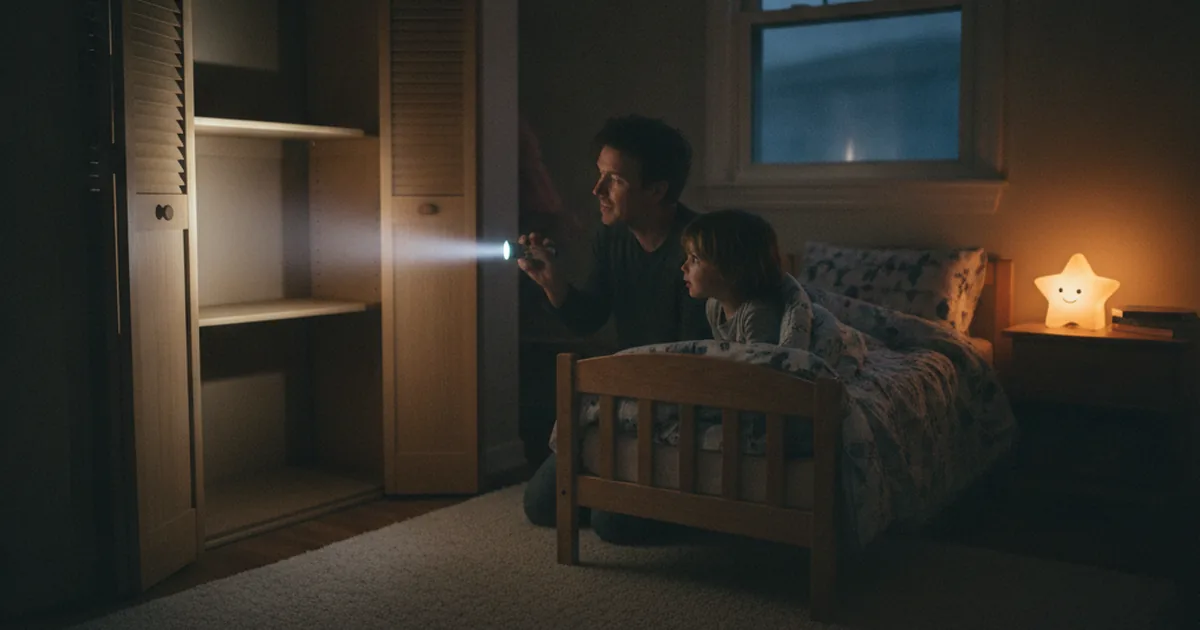
What works better is acknowledging the feeling first, then acting on safety together: "That shadow did look kind of like something. Let's go check." A quick, matter-of-fact "safety check" — opening the closet, looking under the bed, showing them the room with a flashlight — gives a concrete answer their developing brain can actually use, in a way that a verbal reassurance from across the room can't. Many parents find that letting the child hold the flashlight and lead the check gives them a real sense of control, which is often more calming than being reassured from the doorway.
Does a nightlight help, or does it just delay the problem?
A dim nightlight is a reasonable, low-cost accommodation, not a crutch that creates a permanent habit. The color matters more than most parents realize: a warm, amber or red-toned light is much less likely to interfere with the body's melatonin production than a bright white or blue-toned one, so it won't fight against your child actually falling asleep. Keep it low and positioned so it doesn't shine directly into their eyes. As the fear naturally fades — usually over months, not days — most kids stop asking for the nightlight on their own; you rarely need to force the issue.
How much should I let them sleep in my bed?
An occasional night in your bed after something genuinely scary — a nightmare, a thunderstorm, a rough day — isn't going to undo anything. But if it becomes the nightly answer to fear of the dark, it can quietly reinforce the idea that their own room isn't a safe place to be, which tends to make the underlying fear harder to resolve rather than easier. A steadier middle path is staying in their room while they fall asleep — sitting on the edge of the bed, then a chair, then just inside the door — and gradually moving your presence outward over a week or two as their confidence builds. It's slower than just moving them into your bed, but it tends to actually close the loop instead of postponing it.
What role do screens and scary content play?
This one is easy to underestimate. Preschool and early-elementary kids can absorb frightening imagery from a show, a movie preview, a video game, or even an overheard news segment, and it resurfaces exactly when the mind goes quiet at bedtime — the same quiet that makes shadows feel more vivid. Being deliberate about what your child watches during the day, and cutting screens for at least an hour before bed, tends to noticeably reduce how much "material" their imagination has to work with once the lights go out. It's part of why we built Sleepy Spell around audio instead of video: a calm story your child listens to, in a dim room, without a bright screen competing with their body's own wind-down signals, gives their imagination something gentle to land on rather than something to chase away.
Building a routine that keeps fear from taking over bedtime
A consistent wind-down does a lot of quiet work here, because predictability itself is calming to a child whose imagination is working overtime. The same order of steps every night — bath, pajamas, a calm story, lights dimmed gradually rather than snapped off — gives fewer openings for a fresh worry to creep in right at the transition to sleep. If bedtime has become a genuine negotiation on top of the fear itself, it's worth reading through our guide on bedtime stalling tactics, since fear of the dark and ordinary delay tactics often show up together and benefit from the same calm, consistent response.
It also helps to avoid turning the fear into the center of attention during the day. Gentle daytime conversation about what feels scary is fine and even useful, but constantly asking "are you scared of the dark tonight?" can accidentally keep the topic more present than it needs to be. Let bedtime itself be calm and matter-of-fact, and save any deeper conversation for daylight hours when your child's nervous system isn't already keyed up for sleep.
When is it more than a normal phase?
The vast majority of fear of the dark resolves on its own with time and a bit of extra reassurance. It's worth mentioning to your pediatrician if the fear is intense enough to cause real panic, isn't easing (or is getting worse) after several months of a consistent, supportive response, shows up alongside other anxiety during the daytime, or is disrupting sleep badly enough to affect the whole household night after night. This isn't medical advice — a pediatrician or child therapist can help tell the difference between a passing developmental stage and something that could use more targeted support.
This post reflects general parenting guidance and isn't medical advice. If you're concerned about your child's fear or anxiety, please talk to your pediatrician, who can advise on next steps specific to your child.
Frequently asked questions
At what age does fear of the dark usually start?
Most children develop a noticeable fear of the dark somewhere between ages 2 and 4, as imagination and the ability to picture things that aren't there outpace their ability to tell real from pretend. It often peaks around ages 4 to 6 and gradually fades by 7 or 8, though timing varies a lot between kids.
Is it bad to let my child sleep with a nightlight?
No, a dim, warm-colored nightlight is a completely reasonable accommodation and won't create a permanent habit. Choose a low, amber or red-toned light rather than a bright white or blue one, since cooler light is more likely to interfere with melatonin production. Most kids naturally stop needing one as the fear fades on its own.
Should I tell my child that monsters aren't real?
You can say it once, calmly, but repeating it or arguing rarely helps in the moment, because a scared child isn't reasoning logically — their fear response is real even if its trigger isn't. It works better to acknowledge the feeling first ("that shadow really did look scary") and then help them feel safe with concrete actions, like checking the closet together or turning on a light, rather than debating facts.
Will letting my child sleep in my bed make the fear worse?
An occasional night after a genuinely scary event is unlikely to cause harm. But making it the nightly solution tends to reinforce the idea that their own room isn't safe, which can make the fear harder to shake. A steadier approach is staying nearby in their room while they fall asleep and gradually moving your presence toward the door over time, rather than moving them into your bed.
Can screen time or scary shows make fear of the dark worse?
Yes, this is a common and underestimated trigger. Kids as young as preschool age can absorb frightening imagery from shows, movies, or even overheard news and replay it at bedtime, when the mind is quieter and more prone to imagination. Cutting screens at least an hour before bed, and being deliberate about what your child watches earlier in the day, often reduces bedtime fear noticeably.
When does fear of the dark need more than reassurance?
Most fear of the dark is a normal developmental stage. Check in with your pediatrician if the fear is severe enough to cause panic, if it's not improving or is worsening after several months, if it's paired with other anxiety that shows up during the day, or if it's significantly disrupting the whole family's sleep. A pediatrician or child therapist can help rule out or address a more persistent anxiety pattern.
Sources
American Academy of Pediatrics (HealthyChildren.org) — Common Childhood Fears.
ZERO TO THREE — Sleep: What Every Parent Needs to Know.
Sleep Foundation — Toddler Sleep.
American Academy of Pediatrics (HealthyChildren.org) — Media and Children.